
The Ministry of the Environment draws people’s attention to lithium battery sorting – this type of battery, which is increasingly used in everyday objects, must be collected and managed responsibly. If disposed of improperly, they pose a risk to the environment and human health. It is therefore important to know what lithium batteries are “hiding” in your appliances and how to handle them responsibly.
The Ministry of the Environment reminds you that it is always important to follow the manufacturer’s instructions not to use batteries that are damaged, wet or otherwise mechanically affected. Batteries should never be disassembled, squeezed or repaired by yourself: if you notice even minor faults or suspicions, such as the device heating up more than usual during charging, or if it swells, or if there is a crunching noise or a strange smell (in which case you should immediately disconnect it from the mains electricity supply), you should contact a professional for battery repair or repair.
In addition, do not charge the batteries by placing them on a bed or carpet, or by placing them close to open fires, radiators, other high temperature sources, or in car interiors on a hot day or other high temperature sources. Such conditions can cause dangerous chemical reactions or explosions. Batteries must be stored out of the reach of children and animals, dry and safe. When recharging, use only the original chargers provided, do not leave the batteries unattended while recharging, do not leave them overnight to charge, take care not to overheat or overcharge them, and disconnect them from the charging point when finished. Overcharging batteries not only shortens their lifetime, but also increases the risk of overheating and uncontrolled temperature rise, which can cause the battery to catch fire or explode.
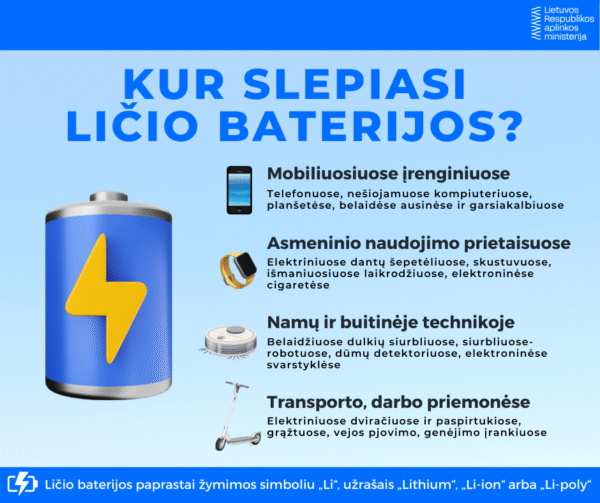
Where are lithium batteries “hiding”?
It is a misconception that lithium batteries are just batteries for mobile phones, smartphones and laptops. In fact, they are used in many other household appliances. They can be found in tablets, wireless headphones and speakers, electric toothbrushes, electric razors, smartwatches, cordless vacuum cleaners and robotic vacuums, power tools (e.g, batteries in drills, lawn mowers and tree pruners), electric bicycles and scooters, as well as smoke detectors, children’s toys, computer game controllers (“consoles”), electronic scales, digital cameras, electronic cigarettes, and even key chains or car keys.
Residents are urged to pay attention to battery labelling – lithium batteries are usually marked with the symbol “Li” and the words “Lithium”, “Li-ion” or “Li-poly”. Whatever the composition of the battery, it is safest to dispose of it in special containers in public places for the collection of batteries, give it to waste handlers or take it to battery collection points.
What happens if I throw a lithium battery or accumulator in the household waste bin?
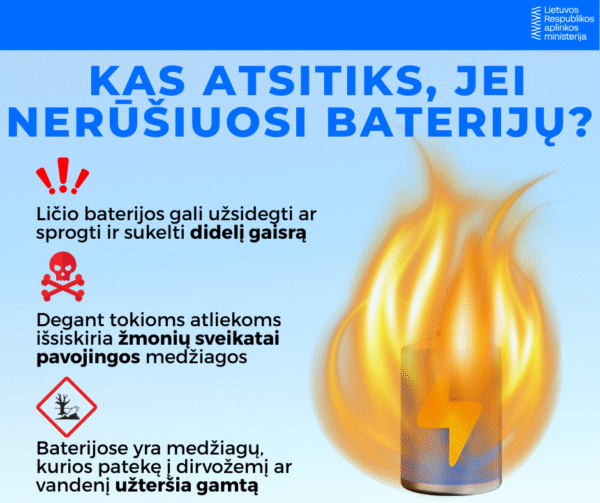
Lithium batteries are hazardous waste and should not be disposed of in general waste or other containers. Due to their chemical composition, cracked or otherwise mechanically damaged lithium batteries and accumulators can ignite or explode, e.g. quickly causing a major fire, especially if thrown away with household waste containing flammable plastic waste. The combustion of such waste releases substances dangerous to human health. In this video you can see how various electronic devices can suddenly catch fire or explode. Unfortunately, such fires have been documented many times in the waste management sector.
Where can I take my waste batteries?
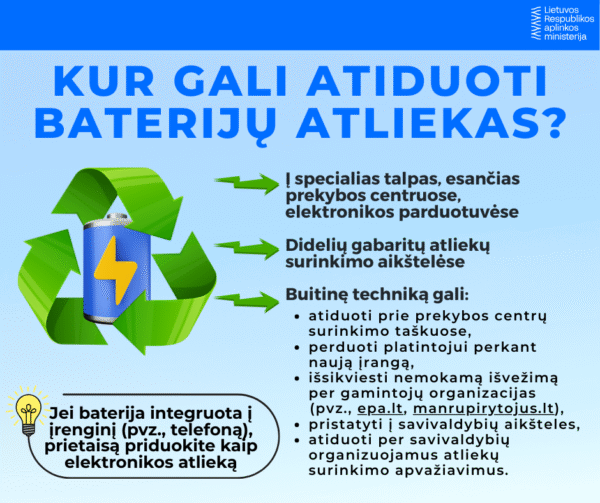
Properly collected batteries protect both the environment and ourselves from these disasters. This is why we remind people to dispose of all batteries and accumulators that are no longer fit for use in special containers for battery waste collection, which can be found in larger supermarkets, electronics shops or delivered to municipal bulky waste collection sites.
If the battery is integrated into a device (e.g. a phone or electronic toy), it must be disposed of with the whole device as e-waste. If you have discarded household appliances or electronic equipment, you can take them to special collection points near supermarkets, or give them free of charge to a distributor who sells the same type of equipment, or have them taken away by producers’ organisations (e.g. https://epa. lt/; https://manrupirytojus.lt/buitines-technikos-isvezimas/), or take them to municipal sites or give them away when the municipalities organise a round-up at least twice a year (for bulky waste collection).
The Ministry of the Environment reminds us that responsible behaviour by everyone contributes to the common goal of a less polluted, safer environment and more sustainable use of resources.
Information from the Ministry of the Environment